


Comparison of Canare Component Video Cables
Cable Solutions' most popular high-performance component video cables
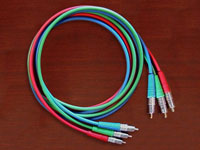
Canare LV-61S
This is a high-performance discrete (single) channel coaxial cable with a stranded copper center conductor, a solid dielectric material, and a braided copper shield. It is highly flexible, long lived, and it comes in ten different colors, which is useful for color-coding. This is our cable of choice for patch cables, and we have used it for HDTV runs over 50 meters (164 feet) with excellent results.
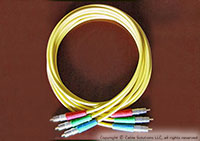
Canare L-4CFB
One might call this the hotrod version of LV-61S. Although the same physical size as LV-61S, it has a solid copper center conductor, a foamed dielectric material for lower loss, a tinned copper braided shield, and a secondary aluminum foil shield. As with all hotrods, some compromises are required in order to achieve higher performance. Compared to LV-61S, it is less flexible and has a shorter expected flex life. We also have it in black and yellow, only. We have customers using this cable at over 75 meters (246 feet) with amazing results.
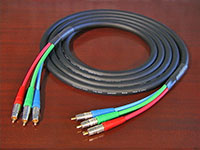
Canare V3-5C
This is a multi-channel jacketed cable -- it has three channels in a single black jacket. The individual channels are somewhat larger than the above discrete cables, and are color-coded red, green, and blue. On paper, it out-performs LV-61S, but the closely bundled channels offsets that theoretical advantage to some extent. It is highly flexible, considering it's size, but it is large cable. Durability probably falls between the other two cables, except in applications where the cable might actually be stepped on, kicked, or otherwise abused, at which point the outer jacket adds a measure of protection. The primary reason to choose this cable would be for aesthetic reasons, if you prefer the appearance of a single cable.
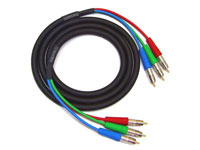
Canare V3-3C
This cable is similar to V3-5C, but has a smaller form factor. It has the advantages of high flexibility, excellent flex life, and a slimmer profile. It is appropriate for runs up to at least 20 meters (66 feet), where the appearance of a single cable is preferred to that of discrete channels. It has most of the flexibility of LV-61S, and performance in shorter runs is superb.